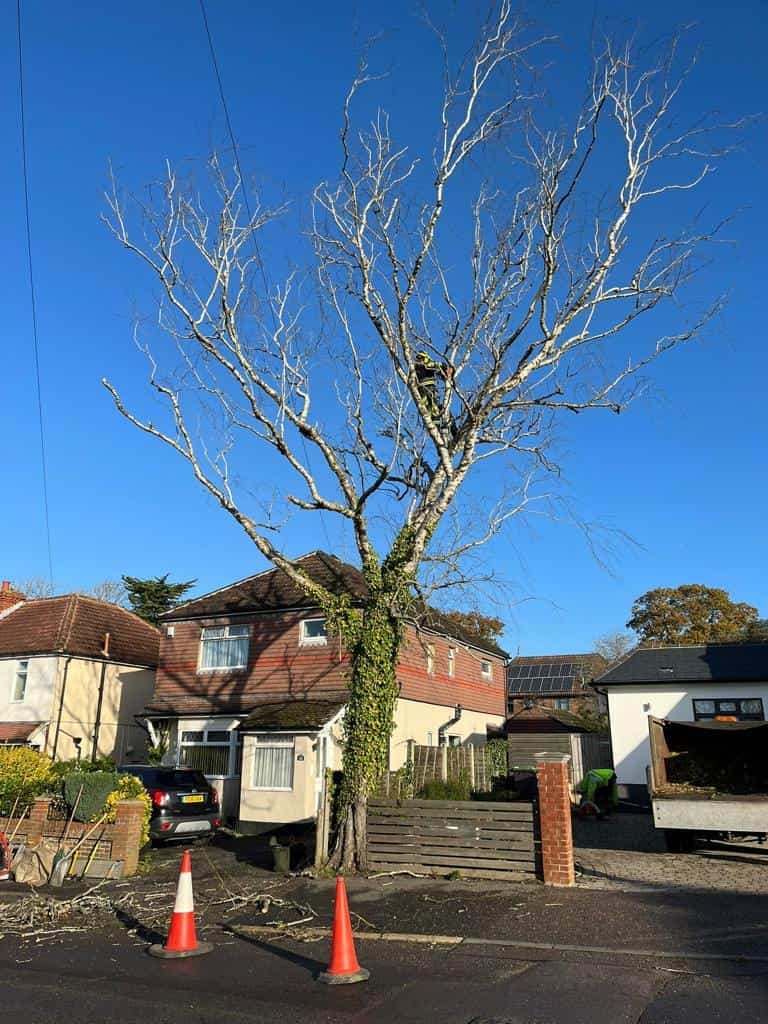
A damaged tree does not automatically need to be felled. Trees can lose branches, develop areas of deadwood or become uneven without the entire tree becoming unsuitable for retention. In many cases, selective pruning, crown reduction or deadwood removal can address the affected areas while preserving healthy growth.
The decision becomes different when damage affects important structural parts of the tree or when several significant defects occur together. Major cracks, repeated branch failures, extensive crown decline or substantial damage to the main stem can leave fewer practical options for managing the tree through pruning alone.
For homeowners in Redhill, Surrey, professional tree assessment is therefore an important first step. Rather than deciding from the tree’s size or one visible defect, the crown, main stem, branch unions, previous failures and overall condition should be considered together. Where targeted tree surgery can retain a suitable tree, felling may be unnecessary. Where deterioration is substantially more extensive, removal can become the more appropriate option.
When Can Tree Felling Become More Appropriate Than Further Tree Surgery?
Tree felling becomes more relevant when the problem affects the tree as a complete structure rather than being confined to individual branches.
A damaged limb can often be removed. A large crown can sometimes be reduced. Localised deadwood can frequently be managed selectively.
When major defects affect several important parts of the tree, however, pruning may no longer provide a proportionate solution.
Major Damage to the Main Stem Requires Careful Assessment
The main stem forms a central part of a tree’s structure.
Damage here can therefore have different implications from damage to an outer branch.
A localised branch defect may sometimes be removed entirely through selective pruning. Significant main stem deterioration cannot necessarily be managed in the same way.
Where substantial cracking, splitting or other deterioration affects the stem, the extent and position of the damage should be professionally assessed.
Large Structural Cracks Can Be Significant
Not every visible crack has the same importance.
Small defects affecting minor branches can present a very different situation from substantial cracks within major structural limbs.
The surrounding wood, branch position and relationship with the rest of the crown all need to be considered.
Where significant cracking affects several important parts of a tree, the options for retaining an appropriate structure can become increasingly limited.
Splitting at Major Branch Unions Can Change the Situation
Large branches often form substantial unions with the main stem or other parts of the crown.
If splitting develops around these areas, simply reducing smaller outer branches may not address the underlying problem.
The importance of the affected branch, extent of the split and condition of the surrounding tree all influence the appropriate response.
Where the defect is significant, professional assessment can establish whether targeted work remains suitable or whether felling needs to be considered.
Repeated Major Branch Failures Should Not Be Viewed Separately
Trees occasionally lose branches without requiring removal.
An isolated failure may result in straightforward remedial pruning while the remainder of the tree continues to develop normally.
Repeated substantial failures create a different picture.
Every major branch loss changes the structure of the remaining crown. Previously sheltered limbs can become more exposed, weight distribution changes and the tree can become increasingly uneven.
Where this pattern continues, assessing the whole tree becomes more important than repeatedly removing individual failed branches.
A Tree Can Become Significantly Unbalanced After Damage
Trees naturally develop asymmetrical crowns, so an uneven shape alone does not mean a tree is unstable.
The cause of the imbalance matters.
If a tree has become strongly one-sided because several major branches have failed, the remaining crown may require detailed assessment.
The question is whether proportionate pruning can create a manageable structure without removing excessive amounts of healthy growth.
If achieving this would require increasingly severe intervention, felling may become a more appropriate consideration.
Extensive Storm Damage Can Affect More Than the Broken Branches
Following strong weather, attention naturally focuses on branches that have visibly broken or fallen.
However, the remaining tree can also have changed.
Major branch unions may have been affected, cracks can develop around damaged areas, and previously supported sections of the crown may become more exposed.
For this reason, significant weather damage should be considered across the complete tree rather than treating each broken branch in isolation.
Repeated Weather-Related Failures Deserve Closer Investigation
One damaged branch following strong winds does not necessarily indicate a fundamentally unstable tree.
Repeated failures are more informative.
If substantial limbs continue to break during periods of strong weather, there may be structural characteristics or existing deterioration contributing to the pattern.
Professional assessment can help determine whether selective management remains appropriate or whether the accumulated damage has substantially changed the condition of the tree.
Widespread Dieback Can Reduce the Amount of Healthy Crown Remaining
Dieback describes the decline of branches within the crown.
A small amount can often be addressed through selective pruning.
Where large areas are affected, the situation deserves broader consideration.
As more of the crown deteriorates, there may eventually be insufficient suitable growth for repeated pruning to provide a meaningful long-term solution.
The distribution and progression of the dieback are therefore important.
Extensive Deadwood Can Indicate Wider Decline
Deadwood is common within trees and does not automatically justify felling.
Individual dead branches can often be removed while retaining the healthy crown.
Extensive deadwood throughout several major sections is different, particularly where it occurs alongside thinning foliage or continuing dieback.
In this situation, the deadwood should be considered as one part of the tree’s overall condition rather than as a series of unrelated branches.
A Rapidly Thinning Crown Can Be an Important Change
Different species naturally produce crowns of different densities.
A relatively open canopy may therefore be entirely normal.
What matters more is a significant change from the tree’s established condition.
If a previously healthy canopy becomes increasingly sparse and this is accompanied by deadwood or branch deterioration, the tree should be assessed to understand whether the decline is becoming widespread.
Continuing Decline Over Several Areas Is More Significant
A single damaged section can often be managed.
Several deteriorating areas can indicate a broader problem.
For example, a tree displaying substantial deadwood on one side, major cracking elsewhere and declining foliage across the upper crown requires a different assessment from one containing a single defective branch.
The relationship between defects often matters more than any individual symptom.
Several Significant Defects Together Can Make Felling More Likely
One of the strongest reasons for considering felling is not necessarily one dramatic defect but the accumulation of several substantial problems.
A tree may have:
- Extensive crown dieback
- Several major dead branches
- Significant structural cracking
- Previous large branch failures
- Serious main stem damage
- A heavily altered or depleted crown
- Continuing deterioration
Each issue needs to be considered in context.
Where several occur together, the possibilities for retaining a suitable tree through proportionate pruning can become considerably more restricted.
A Recent Change in a Tree’s Position Needs Investigation
Some trees naturally grow at an angle.
An established lean does not automatically mean the tree requires removal.
A recent or noticeable change is more relevant.
Where the position of a tree appears to have altered, professional assessment can examine the wider condition and determine whether other changes are present.
The key distinction is between a long-established growth form and something that has developed more recently.
Size Alone Does Not Make a Tree Unstable
Large trees can appear imposing, particularly when they stand close to frequently used garden areas.
Height by itself does not establish that a tree is unstable.
A mature tree with an appropriate structure may remain suitable for retention.
Professional decisions should therefore be based on actual condition and structure rather than assuming that a tall tree should be felled simply because of its dimensions.
An Uneven Crown Does Not Automatically Require Felling
Trees rarely grow into perfectly symmetrical shapes.
Light availability, surrounding vegetation and previous pruning can all influence their form.
An uneven crown only becomes more significant when the reason for the imbalance involves substantial damage, branch loss or other structural deterioration.
Understanding why the crown looks the way it does is therefore essential.
Fungal Growth Should Be Considered as Part of the Wider Assessment
Visible fungal growth around a tree can cause understandable concern.
Its significance cannot be determined from appearance alone.
Different fungi interact with trees differently, so the presence of fungal growth does not by itself confirm that felling is necessary.
Where it appears alongside crown decline, structural changes or other deterioration, it can form part of the wider professional assessment.
Previous Damage Can Influence the Current Condition
A tree’s history matters.
Large branches that failed years earlier may have changed how the remaining crown subsequently developed.
Previous pruning may also have encouraged new growth around older pruning points.
These changes can influence the tree’s present structure.
Professional assessment should therefore consider signs of earlier damage rather than looking only at recent growth.
Severe Previous Pruning Can Create Ongoing Management Challenges
Trees can respond strongly after heavy pruning.
Vigorous shoots may develop, altering the structure and density of the crown.
This does not mean a previously heavily pruned tree automatically requires felling.
It does mean that the resulting growth needs to be considered carefully when planning future management.
Repeatedly carrying out severe reductions simply to keep the tree smaller may not always provide the most appropriate long-term approach.
Topping Is Not an Alternative to Proper Tree Management
When a tree appears unstable or oversized, drastically cutting major branches is not necessarily a suitable way to retain it.
Professional crown reduction is selective and works with appropriate parts of the existing branch structure.
Indiscriminate topping can leave a heavily altered crown and may encourage substantial regrowth.
If retaining a damaged tree would require extreme pruning, it is more appropriate to assess whether retention itself remains a realistic objective.
Crown Reduction Can Sometimes Avoid the Need for Felling
Where the tree remains fundamentally suitable but its size or crown spread has become difficult to manage, crown reduction may offer an alternative.
This involves selectively reducing suitable branches while maintaining an appropriate overall framework.
Crown reduction is most relevant when the issue can genuinely be addressed through managing the crown.
It cannot correct every major structural defect elsewhere within the tree.
Selective Pruning Can Resolve Localised Damage
A damaged tree can sometimes look considerably worse than its actual condition.
One broken limb or several smaller damaged branches can alter the appearance of the crown dramatically.
Where these defects are genuinely localised, selective pruning may remove the damaged growth while retaining the remainder of the tree.
This is why visible damage should be assessed before assuming complete removal is necessary.
Deadwood Removal May Be All That Is Required
If dead branches are the main concern and the remaining tree is suitable, professional deadwood removal can target them specifically.
There is an important distinction between a tree containing deadwood and a tree experiencing extensive decline.
Removing localised dead branches preserves healthy parts of the crown and avoids unnecessary intervention.
Crown Lifting Can Resolve Clearance Problems
A tree can sometimes be described as problematic when the actual issue is low branch clearance.
Branches may extend over garden areas or interfere with normal use beneath the crown.
In suitable circumstances, crown lifting can manage selected lower branches to improve clearance.
Where this addresses the homeowner’s main concern, complete removal may not be necessary.
Tree Surgery Should Have a Defined Objective
Pruning should not simply involve removing branches until a tree appears smaller.
There should be a clear reason for the work.
The objective might be to remove damaged branches, reduce part of the crown, improve clearance or manage deadwood.
A defined objective allows the amount of pruning to remain proportionate.
Where no realistic pruning objective can resolve the underlying structural problems, felling may deserve greater consideration.
More Pruning Is Not Necessarily Safer
It can be tempting to assume that reducing a damaged tree as much as possible will automatically improve the situation.
Trees are living structures, and excessive pruning can significantly alter how the remaining crown develops.
The aim should therefore not be to remove the maximum possible amount of growth.
Professional assessment determines whether appropriate pruning can achieve a sensible outcome without unnecessarily compromising the remaining tree.
Future Regrowth Should Be Considered
Tree surgery should account for what is likely to happen after pruning.
Some trees can produce vigorous new growth following substantial reduction.
If the same conflict quickly returns, repeated heavy pruning may become an ongoing cycle.
Where a damaged tree requires increasingly extensive intervention merely to remain manageable, its longer-term suitability deserves reassessment.
The Tree’s Species Can Influence the Available Options
Different tree species have different growth patterns and responses to pruning.
Some naturally develop broad crowns, while others have different branching characteristics.
The way a tree responds after reduction can also vary.
Professional tree surgery therefore considers the species alongside the individual condition and structure when determining whether pruning provides a realistic alternative to felling.
Location Within the Garden Can Affect the Management Decision
A damaged tree should not be assessed without considering its surroundings.
Its available growing space and relationship with frequently used areas can influence how manageable the tree remains.
This does not mean that proximity alone determines whether felling is appropriate.
Instead, the tree’s condition, dimensions and surrounding space should be considered together when deciding on a suitable management approach.
An Unstable-Looking Tree Is Not Always an Unstable Tree
Visual appearance from ground level can be misleading.
A tree with a dramatic lean or irregular crown may have developed that way over many years.
Conversely, a relatively normal-looking tree may contain defects that are not immediately obvious from a distance.
Professional inspection provides a more useful basis for decisions than appearance alone.
Damage Needs to Be Distinguished From Normal Tree Characteristics
Trees naturally contain irregularities.
Old branch unions, uneven bark, changes in crown density and asymmetrical growth do not all represent significant defects.
Correct assessment involves distinguishing normal characteristics from genuine deterioration.
This prevents unnecessary felling while allowing significant problems to receive appropriate attention.
A Tree That Has Lost Much of Its Crown Needs Broader Assessment
Substantial crown loss can result from storms, previous pruning or progressive branch decline.
When a large proportion of the canopy has been lost, it is important to consider what remains.
The remaining branches may continue to form a suitable crown in some cases.
In others, the tree may have been altered so extensively that further pruning cannot produce a satisfactory long-term structure.
Repeated Remedial Work Can Eventually Become Disproportionate
Periodic tree surgery is normal for many mature trees.
Previous pruning alone is therefore not a reason for felling.
The situation becomes different when each visit involves increasingly extensive remedial work because new major problems continue developing.
At that stage, the overall management strategy deserves review rather than automatically repeating the previous intervention.
When Can Retaining a Damaged Tree Become Impractical?
Retention may become less appropriate where:
- Major structural defects affect several important parts of the tree
- Extensive deterioration leaves limited healthy crown
- Significant branch failures continue occurring
- Previous damage has severely altered the remaining structure
- The main stem contains substantial deterioration
- Proportionate pruning cannot address the underlying problem
- Increasingly severe work would be needed simply to retain the tree
- The overall condition continues to decline despite previous management
These circumstances do not replace professional assessment. They illustrate why some damaged trees eventually require a different approach from continued pruning.
Felling Should Not Be the Automatic First Response
A damaged tree can often be retained.
This is particularly true where defects are confined to individual branches or one part of the crown.
Selective pruning, deadwood removal and appropriate crown management can often address specific concerns without removing the complete tree.
Felling should therefore follow an assessment of the available alternatives rather than being assumed from the outset.
Retention Should Not Be the Automatic Decision Either
It is equally important not to assume that retaining every damaged tree is always the better approach.
Trying to preserve a tree through repeated severe pruning can become counterproductive when significant structural deterioration is already present.
Professional tree surgery involves recognising when an appropriate retention option exists and when the condition of the complete tree makes removal more suitable.
Why Professional Assessment Matters Before Tree Felling
The value of assessment lies in understanding how individual defects relate to one another.
A damaged branch can be considered alongside the remaining crown.
A structural crack can be evaluated in relation to the affected limb.
Previous failures can be considered alongside current growth and continuing deterioration.
This complete picture provides a stronger basis for deciding whether targeted tree surgery can achieve the required result.
Tree Felling Requires Careful Planning
When felling is considered appropriate, the way the tree is removed depends on its condition and surroundings.
A damaged or unstable tree cannot simply be approached as though it were an undamaged tree with a predictable structure.
Weak branches, compromised sections and an irregular crown can influence how the work needs to be organised.
Professional planning is therefore an important part of tree felling itself, not only the decision that precedes it.
Damaged Trees May Need Sectional Removal
Depending on the tree and its surroundings, removing it in controlled sections may be more appropriate than attempting to bring the complete tree down in one movement.
Branches and stem sections can be removed progressively according to the condition and available working space.
The exact method should be determined for the individual tree rather than assuming one felling technique is suitable in every situation.
What Signs Suggest a Damaged Tree Needs Professional Assessment?
Arrange professional assessment if you notice significant changes such as:
- Large structural branches splitting or cracking
- Repeated substantial branch failures
- Extensive deadwood throughout the crown
- Widespread or continuing dieback
- A major reduction in healthy foliage
- Significant main stem damage
- Several serious defects appearing together
- Substantial changes following storm damage
- A recent noticeable change in the tree’s position
- Progressive deterioration over time
- Extensive previous branch loss
- Increasingly severe pruning being needed to manage the tree
These signs do not automatically confirm that tree felling is necessary. They indicate that deciding on further work requires a broader understanding of the tree.
Why Early Assessment Can Provide More Management Options
Waiting until a damaged tree has deteriorated considerably can reduce the range of practical management options available.
Earlier assessment allows developing defects to be understood while there may still be scope for targeted work.
In some cases, appropriate pruning can retain the tree.
In others, assessment may establish that deterioration is already sufficiently extensive for felling to be considered.
Either way, the decision is based on the condition found rather than guesswork.
Professional Tree Felling in Redhill, Surrey
At NS Tree Surgery Redhill, we assess damaged and unstable trees by considering their complete condition rather than focusing only on the most obvious defect.
The crown, structural branches, main stem, previous failures, existing deadwood and likely future development can all influence the recommended approach.
Where selective pruning, crown reduction or deadwood removal provides an appropriate way to retain the tree, these options can be considered. Where damage is substantially more extensive and proportionate tree surgery cannot provide a suitable long-term solution, professional felling may be the more appropriate option.
For homeowners in Redhill, Surrey, this assessment-led approach helps ensure that the work is based on what the individual tree actually requires.
Conclusion
Tree felling can become the most appropriate option when damage or instability affects the tree fundamentally rather than being confined to one manageable area. Significant main stem deterioration, extensive crown decline, repeated major branch failures, severe structural cracking and several serious defects occurring together can all reduce the practicality of continued remedial pruning.
However, visible damage does not automatically mean a tree needs removing. Localised broken branches, manageable deadwood and excessive crown size can often be addressed through targeted tree surgery. The important step is distinguishing between a defect that can be managed and deterioration that affects the complete tree.
If you are concerned about a damaged or unstable tree at your property in Redhill, Surrey, contact NS Tree Surgery Redhill for a professional assessment. We can examine the condition and structure of the tree and determine whether appropriate tree surgery can retain it or whether professional felling should be considered.
Call us on: 01737 303 494
Click here to find out more about NS Tree Surgery Redhill
Click here to complete our contact form and see how we can help with your tree needs.